

On Saturday night Polymarket posted: "JUST IN: Los Angeles to begin activating 125 AI-powered speed cameras Monday, with violators facing fines of up to $500." I read the city's contract with the vendor, the program's Use Policy and the state law behind it. None of them call this system AI. It is a radar that measures speed, a camera that photographs the rear plate of a car going at least 11 mph over the limit, and city staff who approve or reject every notice before it is mailed.
The only place AI shows up in the contract is a clause that bans the vendor from training AI models on LA's data.
The post vs the paperwork
Part of the post holds up. LA's Department of Transportation says the first camera systems activate on Oct 26, 2026, which is Monday, and that it expects all of them to be active by the end of 2026. There are 125 of them.
Three parts are off:
- "AI-powered": No LA, state or San Francisco document I read describes the system as AI. Verra Mobility's own explainer on how its speed cameras work says radar or LIDAR detects speed, the camera triggers on a violation, and "all citations go through law enforcement review before issuance". Verra's June 15, 2026 press release about LA doesn't mention AI either.
- "125 cameras": LADOT counts 125 locations, or systems. The council report says each location gets two cameras, one per direction. The contract bills "$4,450 per camera per month for 125 cameras", so the vendor's paperwork uses "camera" for the two-direction system. The best reading is 125 sites with two cameras each.
- "Fines of up to $500": true, and only at 100 mph or more. The usual range is $50 to $200, and every new site starts with 60 days of warnings only.
The post also reads like all 125 turn on Monday. They don't. FOX 11 and other local outlets report that about 20 sites go live first. LADOT had not published a day-one list as of Saturday, so treat that number as reported, not official.
What goes live Monday
The program is LA's pilot under AB 645, the 2023 state law that added Vehicle Code sections 22425 to 22431. LADOT describes it as a five-year pilot that ends with a report back to the state legislature. The council adopted the program (council file 23-1168) 14-0-1 on March 24, 2026, and approved the Verra contract (council file 26-0707) 12-0-3 on June 10, 2026.
There are 125 locations, with at least 8 in each of the 15 council districts. LADOT's September 2026 district lists (district 1 through district 15) showed all 125 as "Construction". According to the council report, the two cameras at each site go on existing poles such as street lights, and only at mid-block locations, which rules out traffic signal poles.
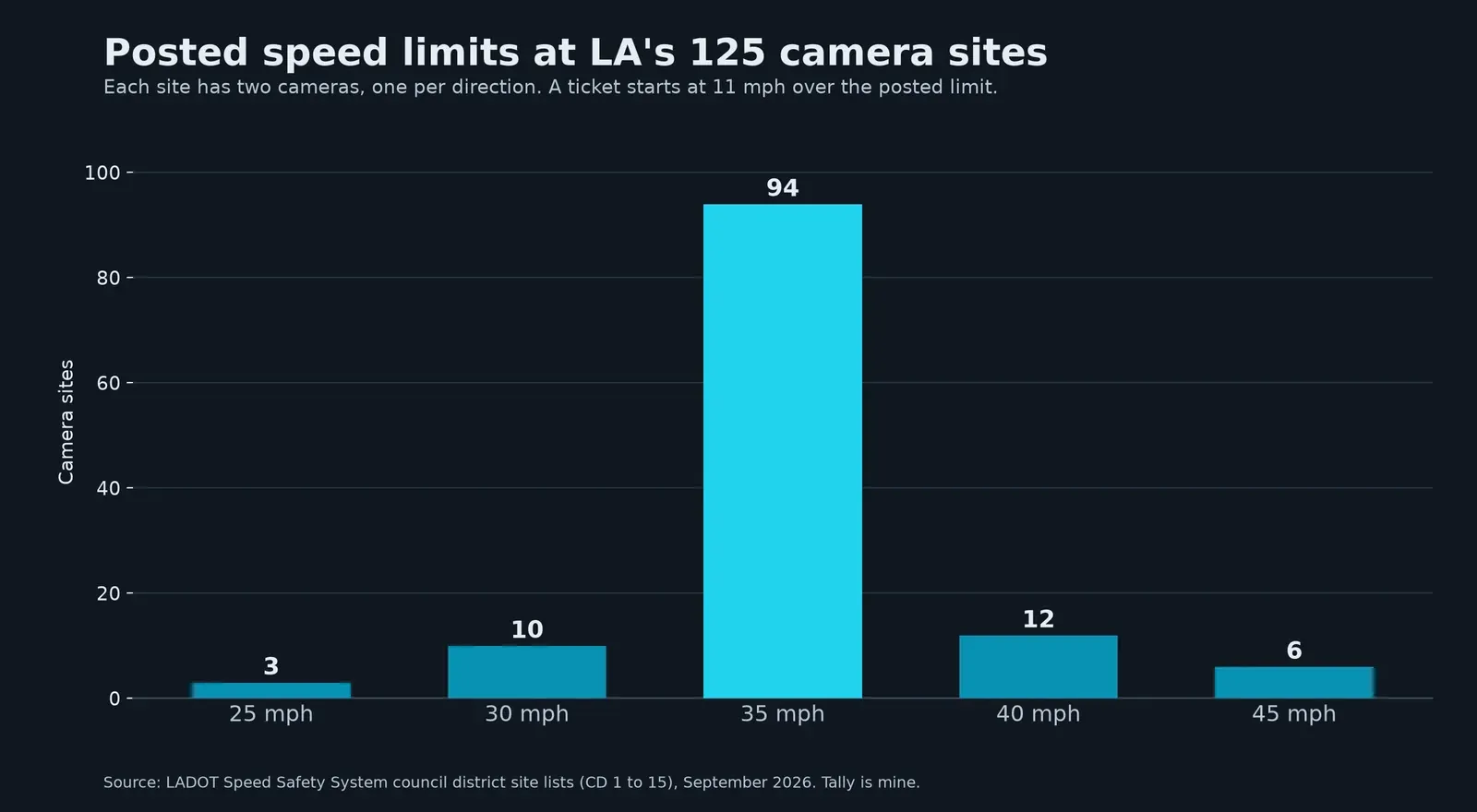
I tallied the posted limits from the 15 district lists. Most of the sites are 35 mph streets:
The sites weren't picked at random. LADOT scored 7,271 street segments on speed-related crashes (30% of the score), a school within 500 feet (15%), high speeding (15%), a senior center (10%), uncontrolled crosswalks (10%), being on LA's VEN street network (10%), NEN speeding hotspots (5%) and LAPD street racing reports (5%). The top 210 went to council offices, and 125 made the final list. In the 30-day public review memo, LADOT reports 193 comments, 66% in support and 33% raising privacy or equity concerns, and says "less than 50%" of the sites are in equity areas.
The 60-day warning period is per site. LADOT's page says it applies "both when the program first launches and whenever new speed safety systems are activated on additional streets." If a site turns on Monday, the earliest real tickets from it come around Dec 25, 2026.
How it works
The state law defines the device as a "radar, laser, or other automated" system, and LA's 2026 impact report describes radar measuring speed. The radar measures the speed of every passing car, which the contract also uses for traffic volume data. The camera takes a still photo of the rear plate and the rear of the vehicle only when a car is at least 11 mph over. Infrared is possible for night shots. There are no driver photos.
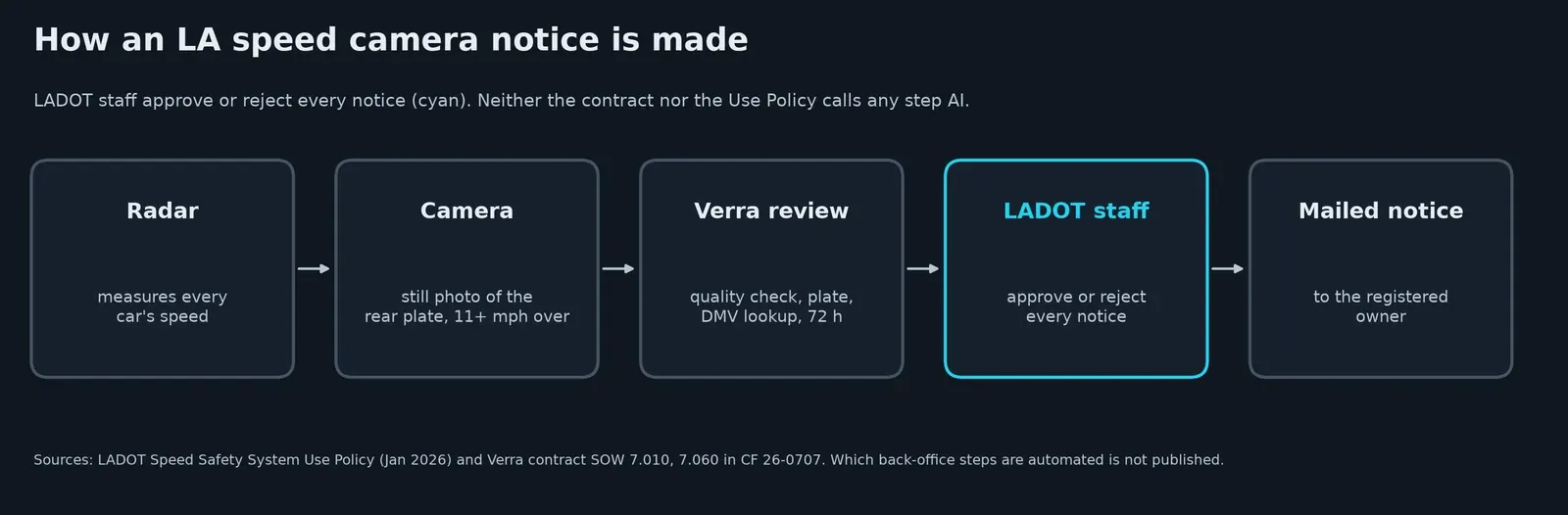
The contract's scope of work spells out the review chain. Verra does "image and data quality review at every stage" and forwards evidence to the city within 72 hours. LADOT staff "review, reject, or approve issuance", and photos are "subject to review and approval by the LADOT staff". AB 645 requires that human review.
The scope of work also sets the record keeping I'd want as an engineer. Verra must calibrate each system every 60 days, and an independent lab must check it at least once a year. The processing system has to log a "non-processing reject code" for every event it drops, the lane each event happened in, and the average and highest speed per site. Verra has to report rejections and the reasons for them every month.
LA hasn't published its hardware model. In San Francisco, where Verra runs the same kind of program, SFMTA posted calibration certificates for a smartmicro UMRR-11 Type 44 radar, certified accurate within 1 mph up to 100 mph by Keystone Compliance on Jan 13, 2025. That's a multi-lane tracking radar, which fits the contract asking for the lane of each event and LA's Use Policy listing "point cloud" as a kind of raw data. I'm assuming LA gets a similar package. The city hasn't confirmed it.
So where's the AI?
Nowhere in the documents, except here. This is the exact sentence from page 46 of the contract package in CF 26-0707:
"Contractor will not use City Data, violation records, or vehicle imagery to develop algorithms, train AI models, or conduct commercial analytics without prior written City approval."
There is one honest gray area. The Use Policy's data table says the processed data includes the plate and state plus "Inferred vehicle type and physical characteristics (e.g., make, model, year, color)", produced "through analysis and manual review". It also lists "Administrative or enforcement determinations (manual or automated)". That leaves room for software that reads plates or sorts images in Verra's back office before a person looks. Neither document says which steps are automated or how. If anything in this system deserves the AI label, it's that back office, and nobody has published what runs there.
Verra sells products abroad that it advertises with onboard AI and plate recognition. I found no evidence any of them are part of LA's program.
What a ticket costs and how to contest it
These are the fines from AB 645 and LADOT's Use Policy:
| Speed recorded | Fine |
|---|---|
| 11 to 15 mph over the limit | $50 |
| 16 to 25 mph over | $100 |
| 26 mph or more over | $200 |
| 100 mph or more | $500 |
The rules around that table matter as much as the numbers:
- For the first 60 days after a system turns on, it only sends warnings.
- A driver's first violation at 11 to 15 mph over is a warning.
- If several cameras catch the same car within 15 minutes, the owner gets one penalty, the highest one. There's no penalty if an officer already cited the same act.
- It's a civil penalty, not a criminal one, and it adds no points to a DMV record.
- Below the federal poverty line, fines can be cut by up to 80%. Up to 250% of the poverty line, by up to 50%. Community service and payment plans are also available.
To contest a notice, the owner requests an initial review within 30 days by phone, mail, online or in person. A hearing can follow within 21 days of the review decision. I couldn't find a live LADOT portal for viewing evidence or contesting yet.
Privacy: what it can and can't do
The rules are tighter than I expected. The Use Policy, AB 645 and the contract prohibit facial recognition, biometrics, identifiable images of drivers or passengers, tracking individual vehicles, and selling or monetizing the data. Police can get the data only with a court order, a subpoena or another legal requirement.
Retention limits are spelled out too. Violation evidence is kept up to 60 days after the case is closed, data on cars that didn't violate up to 5 days, and DMV data up to 120 days. Hosting must be in the US with SOC 2 Type 2 or ISO 27001, and the contract sets a 99.9% uptime SLA.
Compared with a Flock-style plate reader network, the design goal points the other way. A plate reader network exists to build a searchable record of where cars have been. This program photographs and reads the plates of speeders, keeps non-violation data for days, and bans tracking. The one caveat is the radar, which measures every car's speed for traffic counts. A council office newsletter (District 13, Oct 6, 2026) puts it as the cameras "use radar to measure vehicle speed, rather than scanning the license plates of every passing car" and "only take photos of vehicles traveling 11 mph+". That wording comes from a council office, not LADOT, so I'd rate it medium confidence. It matches the Use Policy as far as I can tell.
The money
From the CF 26-0707 report and contract: LA pays Verra (formally American Traffic Solutions, Inc. dba Verra Mobility) $4,450 per system per month for 125 systems. Over 60 months that's $33,375,000, plus up to $5,000,000 in postage reimbursement, for a ceiling of $38,375,000. The term runs May 1, 2026 to Jan 1, 2032. LA didn't run its own bid. It piggybacked on Oakland's competitively bid contract.
The CF 26-0707 report text says "fixed base contract cost of $33,750,000" with a $38,750,000 ceiling. That doesn't match $4,450 × 125 × 60 or the $38,375,000 the council approved, so it looks like a typo. I'm using the council's number.
For scale, SFMTA's 18-month report puts San Francisco's vendor cost at about $1.5 million a year for 33 systems. My division puts that at about $3,788 per system per month against LA's $4,450. Treat that comparison as medium confidence, since it's my math on a rounded figure. SF's first-year revenue was about $6.5 million.
Revenue beyond cost recovery goes to traffic calming through the Traffic Safety Fund (council file 26-0600-S100). That file says collectible citations "could begin on or after October 31, 2026." That conflicts with a 60-day warning period starting Oct 26, which would put the first real tickets around Dec 25. It may be left over from an older schedule. I can't tell from the documents which date is right.
Does it work? San Francisco's first 18 months
LA's case for the program starts with its own numbers. The impact report says 16% of fatal and severe crashes from 2017 to 2021 involved unsafe speed, and cites NHTSA's estimate that speed cameras cut deaths and serious injuries by 20 to 37%.
San Francisco is the closest real test. Per SFMTA's 18-month report (Oct 15, 2026), the first camera went live March 20, 2025, all 33 were active by June 6, 2025, warnings ran from June 6 to Aug 4, and citations started Aug 5, 2025. Since then:
- Speeding by 10 mph or more fell 84% at the camera sites, from 10% of traffic to 1.6%.
- 62.9% of ticketed vehicles never got a second notice.
- The share of citations at 16 mph or more over the limit fell from over 50% to under 3%.
SF sent 588,124 warnings in total and 235,792 notices of violation since August 2025. Different sources quote different SF numbers (72%, 79%, 84%) because they're from different dates. I'm using SFMTA's 84% with its date. Verra's marketing cites bigger numbers that I didn't find in SFMTA's report, so I left them out.
What I could not verify
- Which sites go live on Monday. The list of about 20 comes from FOX 11 and other outlets, not LADOT.
- LA's hardware model, and whether it matches San Francisco's smartmicro radar.
- Whether any automated plate reading or AI runs in Verra's processing for LA, and at which steps.
- When LADOT will publish its first data on warnings, rejects and reject reasons, which the contract requires the vendor to report.
- Whether the 60-day warning clock runs per site or citywide. The statute and the contract's scope of work suggest per site, and LADOT's page says it restarts on new streets.
- Which of the two revenue dates (Oct 31 or about Dec 25) is current.
What I'll watch
The first LADOT data release is what I'm waiting for, especially reject counts and reject reasons by site. Those numbers show how often events get thrown out and why, and they're the closest thing to an accuracy report this program will have. I'll also watch whether that data breaks results out by equity area, since "less than 50%" of the sites are in one, and whether "AI" ever shows up in Verra's LA paperwork. If it does, the contract already says Verra needs the city's written approval to train on LA's data.
Sources
- LADOT, Speed Safety System program page
- LADOT, Program report and policy (council report, Feb 11, 2026)
- LADOT, Attachment B, Use Policy (Jan 2026)
- LADOT, 30-day public review update (Mar 20, 2026)
- LADOT, Speed Safety System impact report 2026
- LADOT, district site list, CD 1 (same path through sss-cd-15.pdf)
- LA City Clerk, council file CF 26-0707 (Verra contract, May 8, 2026 report)
- LA City Clerk, council file CF 23-1168 (program adoption)
- LA City Clerk, council file CF 26-0600-S100 (Traffic Safety Fund)
- California Legislature, AB 645 bill text
- SFMTA, Speed Safety Camera 18-month report (Oct 15, 2026)
- Verra Mobility, How do speed enforcement cameras work?
- Polymarket on X, the original post (Oct 24, 2026)